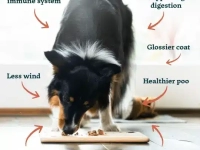
Raw food can help dogs with food allergies, but the mechanism is the protein source, not the diet type. Switching to a protein your dog has never eaten before removes the allergen entirely. Here is how to use that to your advantage.
How does raw food help with food allergies?
Most food allergies in dogs trace back to a specific protein they have eaten repeatedly over a long period. The immune system develops a reaction to it, and symptoms (itchy skin, ear infections, gut upset, fur loss) follow every time that protein appears in the food. Raw feeding helps not because it is raw, but because it gives you precise control over exactly which protein your dog eats.
A 2024 study of 55 dogs found significantly higher local immune markers in raw-fed dogs, including elevated fecal IgA and IgG levels, suggesting raw feeding supports gut-level immunity. For dogs whose allergy symptoms are linked to gut inflammation, this matters.
What are the signs of food allergies in dogs?
Food allergies most commonly show up in the skin, ears, and gut. Itching, scratching, and fur loss are the most obvious signs. Recurring ear infections, red paws, and hot spots, particularly in dogs that have been on the same food for a long time, are worth investigating as dietary rather than environmental reactions.
Alicia Ollie’s Sheprador, Ixi, had been scratching and pulling out his fur for months before the cause became clear:
“My Sheprador was suffering a bad skin condition for a few months. We took him to the vet, tested for mites and everything. Tried at-home and over-the-counter treatments, until it occurred to me that diet is probably the cause. I’ve read that German Shepherds can be allergic to Chicken, and other proteins. As he got worse, scratching and pulling out his fur, a raw diet was on the cards for the new year. I’m so glad I chose Kuri. Both of my dogs love it beyond belief, and within a couple of weeks, his skin condition was basically gone. The hair is still growing back around his legs and belly, but he’s finally able to relax.” — Alicia O
Which protein should I choose for an allergic dog?
Start with a protein your dog has never eaten before. The goal is to remove every possible allergen from the diet so you can see clearly whether food is the cause. Venison is the first choice for most dogs: it is a novel protein that the majority of dogs on commercial kibble have never been exposed to.
If your dog has a known or suspected chicken sensitivity, Kuri’s lamb only mix is the most practical starting point. It contains lamb, lamb heart, and lamb tripe: a single protein source throughout, with no chicken anywhere in the recipe. For an elimination trial to work, the entire diet needs to be one protein. A recipe with traces of chicken will not give you a clean result.
If lamb does not resolve symptoms after a full trial, rabbit heart and tripe is the next step. Rabbit is naturally lean, easy to digest, and another protein most dogs have no prior exposure to.
Proteins to avoid during an allergy trial: Chicken and beef are the most common proteins in commercial dog food. If your dog has been eating any of these regularly, they are the most likely culprits and should be excluded from the trial.
How do I run an elimination diet trial?
Feed a single novel protein exclusively for a minimum of eight weeks. No treats (except lamb ones), no table scraps, nothing containing the excluded proteins. Most dogs that respond to a dietary change show clear improvement within two to four weeks, but running the full eight weeks before drawing conclusions gives a more reliable result.
What to watch for as the trial progresses: reduced scratching, less ear discharge, firmer stools, skin starting to clear. Vickt T. noticed the difference in her Leonberger within weeks of switching to Kuri’s venison range:
“After feeding my Leonberger, who was struggling with allergies and skin issues. We started buying venison, heart and tripe from Kuri, we won’t go anywhere else now. His weight is improving, his energy is increasing and he fricken loves it.” — Vickt T.
If symptoms resolve during the trial, reintroduce the original food. If symptoms return, the diagnosis is confirmed. If symptoms do not resolve after eight weeks on a novel protein, an environmental allergy (pollen, dust mites, contact allergens) is more likely than a food allergy, and a vet visit is the right next step.
Where do I start in NZ?
Kuri City’s raw range is available online, with same-day delivery in Christchurch and overnight across the South Island. For an allergy trial, start with either:
- Lamb only mix: single protein (lamb, lamb heart, lamb tripe), ideal for dogs with suspected chicken sensitivity
- Rabbit heart and tripe: lean single protein, suitable for dogs that have already tried lamb or need a lower-fat option
For the transition from kibble, use the 10-day transition guide. During an allergy trial, the transition protein must be the novel protein you are trialling. Do not mix with the original food beyond the transition period.
Frequently asked questions
Can dogs grow out of food allergies?
Food allergies in dogs do not typically resolve on their own. Once a dog develops a reaction to a specific protein, avoiding that protein is the long-term management approach. Rotating novel proteins after a successful trial helps reduce the risk of developing a new sensitivity over time.
How do I know if it is a food allergy or an environmental allergy?
Food allergies tend to cause year-round symptoms that are consistent regardless of season. Environmental allergies (grass, pollen, dust mites) often follow seasonal patterns or worsen in specific settings. An elimination diet trial is the most reliable way to distinguish the two at home, though a vet can also perform allergy testing.
Can I use treats during an elimination trial?
No. Any treat containing the excluded protein will contaminate the trial. During the eight-week period, use only single-ingredient treats made from the same novel protein you are trialling, for example a lamb-based treat if you are running the lamb only mix trial.
Is venison available in NZ raw dog food?
Yes. Kuri’s raw range includes venison options, available online with delivery across the South Island. Browse the full range for current availability.
Should I tell my vet I am switching to raw for an allergy trial?
Yes. A vet can help confirm whether symptoms are consistent with a food allergy, rule out other causes (mites, contact dermatitis, atopic dermatitis), and advise on whether the trial protocol suits your dog’s situation. Raw feeding and veterinary care are not mutually exclusive.
Choose the right KURI raw food
Use our raw-feeding guide and portion calculator to compare proteins and estimate a sensible starting amount for your dog.
Shop KURI raw dog food for convenient frozen medallions. We aim for same-day Christchurch delivery when you order before 9am. Overnight South Island delivery excludes rural delivery addresses.
When a less-common protein is appropriate, our Rabbit, Heart and Tripe medallions are one option to discuss with your vet. Use the KURI raw-feeding guide to work out a starting portion and transition plan.
 01Sep
01Sep