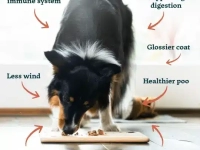
Switching a dog from kibble to raw takes about 10 days. You replace a small portion of their current food with raw each day, letting the gut adjust before the next increase. Most dogs move through it without any trouble — the ones that slow down need a few extra days at one stage, not a trip back to the bag.
What is the transition schedule?
Replace a quarter of your dog’s kibble with raw food and increase every three days over 10 days. Going slowly gives the gut microbiome time to adapt and prevents the digestive upset that causes new raw feeders to give up at the first hurdle.
| Days |
Kibble |
Raw |
| 1–3 |
75% |
25% |
| 4–6 |
50% |
50% |
| 7–9 |
25% |
75% |
| 10+ |
0% |
100% |
Feed the same total weight you were feeding before. If your dog was on 200g of kibble per day, use 200g total (kibble plus raw combined) through the transition, then adjust to the correct raw feeding amount once fully switched.
How much raw food should I feed?
Feed 2–3% of your dog’s body weight per day once fully switched. A 10kg dog needs 200–300g daily; a 20kg dog needs 400–600g.
| Dog’s weight |
Daily amount at 2% |
Daily amount at 3% |
| 5kg |
100g |
150g |
| 10kg |
200g |
300g |
| 20kg |
400g |
600g |
| 30kg |
600g |
900g |
Use Kuri’s raw food calculator to get a precise amount based on your dog’s weight, age, and activity level. Small dogs often need to sit closer to 3% due to their higher metabolic rate — if you’re feeding a small breed, the complete guide to raw feeding small dogs in NZ covers portion sizing by weight class.
What if my dog gets loose stools or mucus?
Hold at the current ratio — do not go back to full kibble. Loose or mucus-coated stools during a raw transition are normal and almost always resolve within a day or two. The gut microbiome is adjusting to a fundamentally different food source, and that adjustment takes a little time.
Going back to full kibble resets the process and means starting again. Hold at the ratio your dog is on until stools firm up, then continue to the next stage. If symptoms last more than three to four days or your dog seems unwell, call your vet.
This is the most common point where new raw feeders stop — not because the diet failed, but because they expected a smooth ride and did not know a day of soft stools was part of the process. It passes.
Why does raw food change a dog’s stools?
Raw-fed dogs digest food significantly more efficiently than kibble-fed dogs, which means much less waste. A 2025 peer-reviewed study found protein digestibility of 95.7% in raw-fed dogs compared to 57.1% in kibble-fed dogs. The practical result: smaller, firmer stools once the gut has adjusted — but during the transition, you will see the adjustment happening in real time.
The gut microbiome also shifts significantly during the switch. A 2024 study of 55 dogs found greater microbiome diversity and higher immune markers in raw-fed dogs. That shift takes a few days to stabilise, which is why the transition schedule exists.
Which protein should I start with?
Start with a single protein. Venison, beef, and lamb are all good first choices. Chicken is fine for most dogs but can be reactive for dogs with existing skin issues or known food sensitivities — if your dog has a history of allergies, start elsewhere.
Vickt T. started her Leonberger on venison, heart and tripe from Kuri after months of allergy and skin problems:
“After feeding my Leonberger, who was struggling with allergies and skin issues. We started buying venison, heart and tripe from Kuri, we won’t go anywhere else now. His weight is improving, his energy is increasing and he fricken loves it. Which, everyone knows is the main thing. Thanks for your products, we will see you every couple of weeks.” — Vickt T.
Browse Kuri City’s raw range for single-protein options with same-day delivery in Christchurch and overnight across the South Island.
Frequently asked questions
How long does it take a dog to adjust to raw food?
Most dogs adjust fully within 10–14 days. Some are fine within a week; dogs with sensitive stomachs or a long history of kibble may need up to three weeks. Follow your dog’s stools as the guide, not the calendar.
Can I switch my dog straight to raw without a transition?
Some dogs can. Active young dogs with no history of digestive issues sometimes handle an immediate switch without any problems. For older dogs, dogs with sensitive stomachs, or any dog that has been on the same kibble for years, a gradual transition is the lower-risk approach.
What is the best raw food to start with in NZ?
A single-protein option from a commercially formulated range. Kuri’s raw range is made to the 80:10:10 ratio (80% muscle meat, 10% raw bone, 10% organ meat) and is available in multiple proteins. Browse the range.
What if my dog won’t eat raw food?
Try warming the raw food slightly (not cooking it — just taking the chill off) to release more aroma. Mixing a small amount of bone broth over the top also helps. Kuri’s beef bone broth pours straight over kibble or raw and is particularly good for picky dogs at the start of the transition.
Can I mix raw and kibble in the same bowl?
Yes, during the transition. Some feeders prefer to separate the meals (raw in the morning, kibble at night) in the early stages, but mixing in the same bowl works fine for most dogs. Once fully switched, there is no reason to continue mixing.
Choose the right KURI raw food
Use our raw-feeding guide and portion calculator to compare proteins and estimate a sensible starting amount for your dog.
Shop KURI raw dog food for convenient frozen medallions. We aim for same-day Christchurch delivery when you order before 9am. Overnight South Island delivery excludes rural delivery addresses.
 01Sep
01Sep